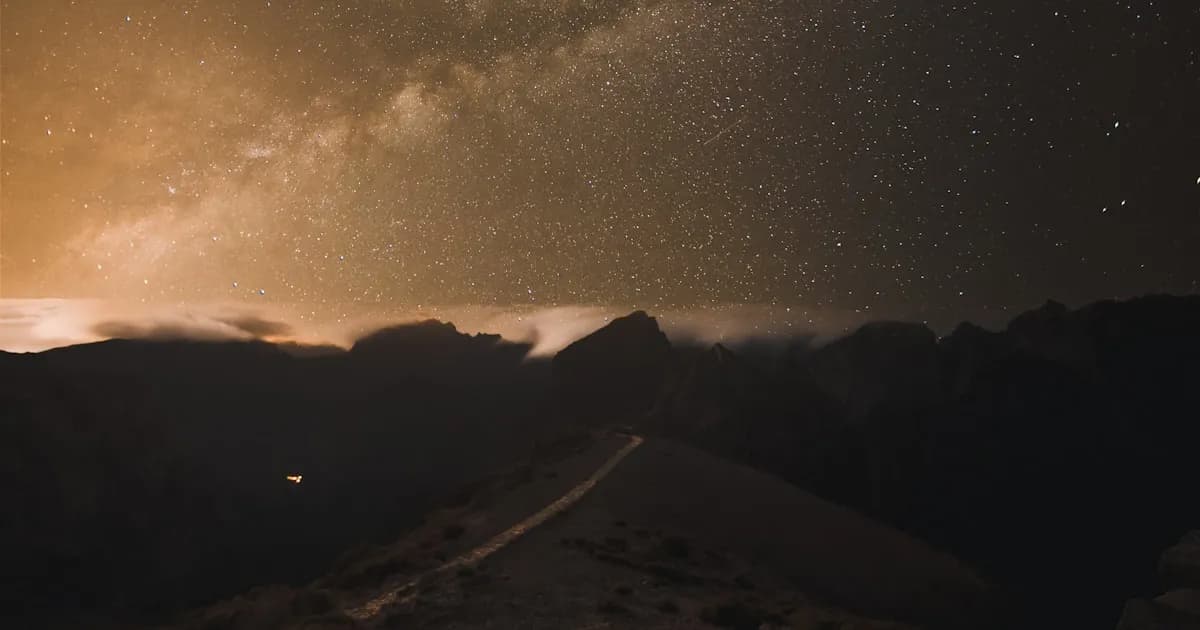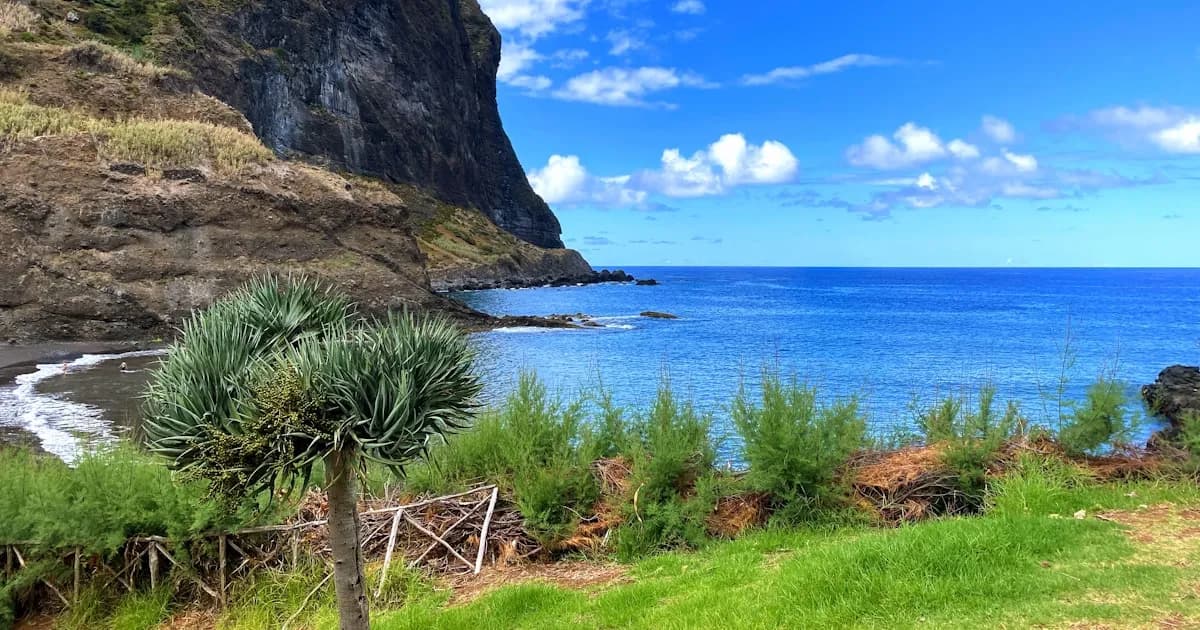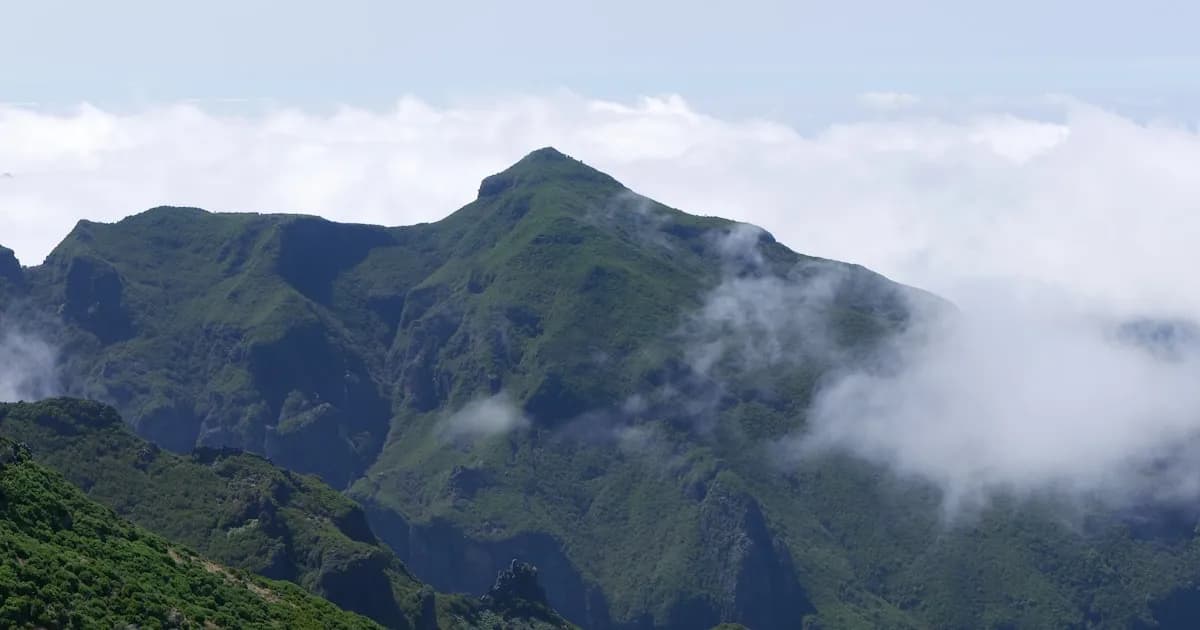
Most people come to Madeira for what they can see during the day — volcanic peaks, laurel forests, ocean cliffs. But when the sun drops below the Atlantic horizon and the last light fades, a different spectacle begins. Madeira has some of the darkest skies in western Europe, and on a clear night above 1,500 metres the Milky Way is so bright it casts a faint shadow on the ground.
This guide covers the best stargazing locations on the island, the Milky Way season, a month-by-month meteor shower calendar, what equipment to bring, light pollution conditions, guided tour options, and how to turn a night of stargazing into a full adventure by adding a sunrise hike and a zipline the next morning.
Why Madeira Is Exceptional for Stargazing
Madeira sits at 32°N latitude in the middle of the Atlantic Ocean, over 600 kilometres from the nearest continent. This isolation means there is no light dome from a major mainland city bleeding into the sky. The island's population is concentrated along the southern coast below 500 metres, and once you climb above 1,000 metres you leave virtually all artificial light behind.
The volcanic peaks reach nearly 1,900 metres — high enough to rise above the marine cloud layer that often sits at 800–1,200 metres. This means that even on nights when the coast is overcast, the mountaintops can be perfectly clear with stable, dry air above. For astronomy, that combination of altitude, isolation, and a frequent temperature inversion is close to ideal.
Add Madeira's subtropical latitude and you get access to a wider band of sky than anywhere in northern Europe. Constellations like Scorpius and Sagittarius — which barely scrape the southern horizon from London or Berlin — climb high enough here to be observed properly, and the galactic centre of the Milky Way passes almost overhead during summer.
Best Stargazing Spots
Pico do Arieiro (1,818 m)
The third-highest point on the island is the most accessible high-altitude stargazing location. A paved road leads all the way to the car park at the summit, and there is a large open viewing platform with unobstructed views in every direction. On clear nights, the absence of light pollution is immediately obvious — the sky looks different from anything you have seen from a European city.
Why it works: The altitude puts you above most cloud and haze. The viewing platform provides a flat, sheltered area to set up a tripod. There is no artificial lighting at the summit after the small cafe closes. The 360-degree horizon means you can track objects from rise to set without obstruction.
Practical tips:
- Drive up before sunset to secure a parking spot and get oriented while you can still see
- Temperatures drop to 5–10 °C even in summer — bring a fleece, windbreaker, hat, and gloves
- The road is open 24 hours but can be closed in extreme weather
- Mobile signal is intermittent — download star maps offline before you go
Pico do Arieiro is also Madeira's most famous sunrise spot. Stay for the night, watch the stars, then experience the dawn breaking over the cloud sea — it is one of the most complete natural spectacles you can witness in Europe.
Paul da Serra (1,400 m)
Paul da Serra is a high-altitude plateau in the western part of the island — the only flat landscape in Madeira. At roughly 1,400 metres elevation and covering an area of about 25 square kilometres, it offers something the peaks cannot: a vast, open, almost perfectly flat horizon in every direction. For stargazing, this is significant because you get an uninterrupted view all the way down to the horizon line, which is essential for observing objects at low altitude and for panoramic Milky Way photography.
Why it works: The plateau is uninhabited and unlit. The nearest village with street lighting is over 500 metres below. The flat terrain means you can set up equipment anywhere along the road that crosses the plateau. The western position on the island means the Atlantic lies to the west with zero light pollution on the horizon.
Practical tips:
- Park along the ER110 road that crosses the plateau — there are several pull-offs with firm ground
- Wind exposure is significant on the plateau with no shelter, so dress for it and secure your tripod
- Fog can roll in quickly — if the cloud layer rises above 1,400 metres, visibility drops to zero within minutes
- The drive from Funchal takes about 50 minutes via Ribeira Brava
Pico Ruivo (1,862 m)
The highest point in Madeira is the ultimate stargazing location for those willing to earn it. There is no road access — you need to hike in, either from Achada do Teixeira (roughly 45 minutes each way) or from Pico do Arieiro (3 hours one way). The reward is the darkest sky on the island and a feeling of complete isolation above the world.
Why it works: At 1,862 metres, this is the highest and most remote accessible point on the island. There is a small mountain shelter (Casa de Abrigo) near the summit that can be used as a windbreak. The sky at this altitude, on a night with good transparency, is extraordinary.
Practical tips:
- The hike from Achada do Teixeira is the shortest approach — a well-marked trail of about 2.5 km
- Bring a headlamp with red-light mode so you do not ruin your night vision
- Hiking in the dark requires care — the trail has exposed sections with steep drop-offs
- Consider going up in the late afternoon, watching sunset, stargazing, and then hiking out at dawn
If the idea of hiking to Pico Ruivo at night feels too ambitious, Pico do Arieiro delivers 90% of the experience with drive-up access. Both are excellent — the difference is the last few hundred metres of altitude and the solitude.
Milky Way Season — April to September
The core of the Milky Way — the dense, bright band of our galaxy's centre — is only visible during certain months. In Madeira, the season runs from April to September, with the best viewing between May and August.
Here is what to expect month by month:
| Month | Milky Way Core | Best Viewing Time | Notes | |-------|---------------|-------------------|-------| | April | Rises late, visible from ~02:00 | 02:00 – 05:00 | Season opener, core low on horizon | | May | Rises earlier, visible from ~00:30 | 00:30 – 04:30 | Core higher, excellent conditions | | June | Visible from ~23:00 | 23:00 – 04:00 | Peak season begins, short nights | | July | Visible from ~22:00 | 22:00 – 03:30 | Peak season, core nearly overhead | | August | Visible from ~21:30 | 21:30 – 02:00 | Peak conditions, warm nights | | September | Visible from ~20:30 | 20:30 – 00:30 | Core visible in early evening, season winding down |
The new moon period — roughly five days centred on the new moon date — provides the darkest skies. Plan your stargazing trip around the lunar calendar for the best results. Even a half moon (first or last quarter) washes out the fainter details of the Milky Way.
The Milky Way core sets earlier each week as summer progresses. In June, you might need to wait until nearly midnight. By September, it is already visible at dusk — making it far more convenient to photograph before heading to bed at a reasonable hour.
Meteor Shower Calendar
Madeira's dark skies and southerly latitude make it an excellent location for meteor shower observation. Here are the major showers visible from the island:
| Shower | Peak Dates | Rate (ZHR) | Best Viewing | Notes | |--------|-----------|-------------|--------------|-------| | Quadrantids | 3–4 January | 120 | 02:00 – dawn | Strong but short peak, radiant in Boötes | | Lyrids | 22–23 April | 20 | Midnight – dawn | Moderate, occasional bright fireballs | | Eta Aquariids | 5–6 May | 50 | 03:00 – dawn | Halley's Comet debris, best from southern latitudes | | Delta Aquariids | 29–30 July | 25 | Midnight – dawn | Warm summer nights, pairs well with Milky Way | | Perseids | 12–13 August | 100 | 22:00 – dawn | The most popular shower, reliable and bright | | Orionids | 21–22 October | 20 | Midnight – dawn | Fast meteors, another Halley's Comet stream | | Geminids | 13–14 December | 150 | 21:00 – dawn | The strongest annual shower, multi-coloured |
The Perseids in August and the Geminids in December are the highlights. The Perseids coincide with peak Milky Way season and warm nights at altitude, making mid-August the single best time for a dedicated stargazing trip to Madeira. The Geminids are stronger in raw numbers but fall in winter when mountaintop conditions are colder and cloud is more frequent.
Light Pollution Map
Madeira's light pollution profile is remarkably favourable for an inhabited island:
- Funchal and the south coast (0–300 m): Moderate light pollution. You can see bright stars and planets, but the Milky Way is washed out. Bortle class 5–6.
- Mid-altitude (500–1,000 m): Noticeably darker. The Milky Way becomes visible on clear, moonless nights. Bortle class 4.
- High altitude (above 1,200 m): Genuinely dark. The Milky Way is bright and structured, zodiacal light is visible, and faint deep-sky objects can be seen with binoculars or small telescopes. Bortle class 2–3.
- Paul da Serra and the peaks: The darkest locations on the island, comparable to the best sites in mainland Portugal's Alentejo region. Bortle class 2.
The north coast villages (São Vicente, Porto Moniz, Santana) produce minimal light pollution due to their small size. If you are on the north side of a peak, the sky to the south — toward Funchal — will show a faint glow on the horizon, but it does not significantly affect overhead viewing.
Madeira has no heavy industry and limited highway lighting. The main source of light pollution is Funchal's urban area. Even from the capital, driving just 30 minutes uphill dramatically improves sky quality.
Equipment — What to Bring
For Visual Observation
You do not need a telescope to enjoy Madeira's dark skies. In fact, the naked eye is the best instrument for taking in the full sweep of the Milky Way and watching meteor showers. That said, a few items will enhance the experience:
- Binoculars (7x50 or 10x50): The single most useful piece of astronomy equipment. A good pair reveals star clusters, nebulae, and the moons of Jupiter. The 50 mm aperture gathers enough light to show detail in the Milky Way that the naked eye cannot resolve.
- Red-light headlamp: White light destroys your dark adaptation, which takes 20–30 minutes to develop fully. A headlamp with a red-light mode lets you move around, check maps, and find equipment without resetting your eyes.
- Star chart or app: Stellarium (free, available offline) is excellent. Download the star catalogue before you leave your hotel — mobile data is unreliable at altitude.
- Reclining chair or mat: Stargazing means looking up for extended periods. A lightweight camping chair that reclines, or even a yoga mat on the ground, saves your neck.
For Astrophotography
- Camera with manual mode: Any camera that allows you to set ISO, aperture, and shutter speed manually will work. Full-frame sensors perform best in low light, but APS-C and Micro Four Thirds cameras produce excellent results too.
- Fast wide-angle lens: An aperture of f/2.8 or wider is ideal. A 14–24 mm range on full frame (or 10–18 mm on APS-C) captures the full arc of the Milky Way.
- Sturdy tripod: Wind at altitude will shake a flimsy tripod. Carbon fibre is lighter for the hike up, but any stable tripod with a hook for hanging a weight bag works.
- Intervalometer or remote shutter: Eliminates camera shake during long exposures. Many modern cameras have a built-in interval timer — check yours before the trip.
- Spare batteries: Cold temperatures drain batteries fast. Keep spares in an inside pocket close to your body.
A smartphone with night mode can capture surprisingly good Milky Way images on Madeira's dark skies. The latest flagship phones from Apple and Samsung produce results that would have required a DSLR just five years ago. If you do not own dedicated camera gear, your phone is worth trying.
Guided Stargazing Tours
Several operators on Madeira offer guided stargazing experiences, typically combining transport to a high-altitude location with telescopes, laser-guided constellation tours, and expert commentary. These tours are a good option if you do not have your own equipment or want a structured introduction to the night sky.
What to look for in a guided tour:
- Location: The best tours go to Pico do Arieiro or Paul da Serra. Avoid any tour that stays below 1,000 metres — the sky quality will be significantly worse.
- Equipment provided: A good tour should offer at least one telescope (ideally a Dobsonian or Schmidt-Cassegrain with 8–12 inch aperture) plus binoculars. Laser pointers for constellation identification are standard.
- Guide qualifications: Look for guides with genuine astronomy knowledge, not just scripted commentary. The best guides adapt the session to what is actually visible that night.
- Moon phase awareness: A reputable operator will schedule tours around the new moon and will be transparent about reduced visibility during brighter moon phases.
- Duration: Allow at least 2 hours of actual observation time after reaching the site. Your eyes need 20–30 minutes just to dark-adapt fully.
Tour prices typically range from 40 to 80 euros per person, including transport from Funchal. Some operators offer private tours for small groups, which allow for a more personalised experience and better access to the telescope.
Combine Stargazing + Sunrise Hike + Zipline
One of the best adventure combinations on Madeira starts at night and runs until the following afternoon. Here is how to structure it:
Night: Stargazing at Pico do Arieiro
Drive up to Pico do Arieiro in the evening, arriving at least an hour after sunset for fully dark skies. Spend two to three hours watching the Milky Way, spotting meteors (if timing aligns with a shower), and scanning deep-sky objects with binoculars. The viewing platform at the summit is your base.
Dawn: Sunrise Over the Cloud Sea
As the sky begins to lighten in the east, put away the astronomy gear and prepare for one of Europe's most spectacular sunrises. The cloud inversion that often forms below the peak turns the valleys into a sea of white, with only the highest summits poking through. The colour shift from deep blue to orange to gold happens over about 20 minutes — have your camera ready.
Morning: Hike to Pico Ruivo
With the sunrise light painting the ridgeline gold, set off on the PR1 trail toward Pico Ruivo. The morning hours are the best time for this hike — the air is cool, the light is soft, and the cloud sea is still intact. The 7 km trail takes 2.5 to 3 hours one way, passing through tunnels and along exposed ridges with views that stretch to the horizon. Turn around at Pico Ruivo and return to Arieiro, or arrange a transfer from Achada do Teixeira.
Afternoon: Zipline and Giant Swing at Porto Moniz
After the hike, drive to the north coast and finish the adventure with a rush of adrenaline. The zipline at Porto Moniz with Adrenaline Adventures sends you flying over the dramatic coastal cliffs, and the giant swing adds another dose of excitement. After a night without sleep and a mountain hike, the burst of speed and the ocean air will wake you up better than any coffee.
This combination works best from May to September, when nights are warmest, the Milky Way is visible, sunrise is early, and the weather is most reliable at altitude. Book your zipline slot in advance to lock in an afternoon time.
Practical Tips for a Stargazing Night
- Check the weather forecast obsessively. Clear skies at altitude are not guaranteed. The IPMA (Portuguese meteorological service) provides mountain-specific forecasts. Cloud cameras at Pico do Arieiro are updated regularly and show real-time conditions.
- Check the moon phase. A full moon turns a Bortle 2 sky into a Bortle 5. Plan around new moon for the best experience.
- Dress for winter even in summer. At 1,800 metres, overnight temperatures can drop below 5 °C. Wind chill makes it feel colder. Bring layers: thermal base, fleece, windproof jacket, hat, gloves.
- Bring food and hot drinks. There are no facilities open at night at any of the stargazing locations. A thermos of hot tea or coffee and some energy-rich snacks make a long night far more comfortable.
- Tell someone where you are going. Mountain conditions can change quickly. Leave your plan with someone at your hotel.
- Do not drive tired. If you spend the whole night on the mountain, you will be exhausted by morning. Either nap in the car before driving down or have a second driver.
Best Time to Visit for Stargazing
| Factor | Best Period | Notes | |--------|------------|-------| | Milky Way visibility | May – August | Core visible for several hours, warm nights | | Meteor showers | August (Perseids) / December (Geminids) | Perseids combine with Milky Way season | | Clear skies probability | July – September | Driest months, fewest clouds at altitude | | Comfortable temperature | June – September | Nights above freezing at altitude | | Fewest tourists | October – November | Dark skies, fewer cars at summit car parks | | Overall best | August | Perseids + Milky Way + warm + dry + long nights start early |
Book Your Madeira Adventure — Check PricesFrequently Asked Questions
Is Madeira suitable for families?
Yes, Madeira is very family-friendly. The panoramic zipline has no minimum age — anyone weighing 35 kg to 120 kg can ride, and there are easy levada walks suitable for all ages.
Is Madeira good for solo travellers?
Excellent. It is one of Europe's safest destinations with a growing digital nomad community, especially in Ponta do Sol.
Can seniors enjoy Madeira?
Absolutely. The mild climate, gentle levada walks, cultural attractions, and excellent healthcare make it ideal for over-50s.
Is Madeira romantic?
Very. Sunset boat cruises, cliff-top restaurants, tandem zipline experiences, and wine tastings make it perfect for couples.
Read Also
- 25 Best Things to Do in Madeira — The ultimate activity guide to the island, from levada walks to ziplines and everything in between.
- Pico do Arieiro to Pico Ruivo — Madeira's Most Iconic Hike — Everything you need to know about the PR1 trail that connects the island's highest peaks.
- Photography Guide to Madeira — Best spots, golden hour times, drone rules, and gear tips for capturing Madeira at its finest.